


Small businesses face a constant balancing act: finding new customers while keeping existing ones, staying competitive without overextending resources, and growing without losing the agility that makes small teams effective in the first place.
Whether you’re running a well-established business or navigating an early growth phase, the fundamentals of sustainable growth remain consistent. Here are six proven strategies to accelerate your small business growth, and how to put them into practice.
1. Grow Your Market Share
Increasing your market share is one of the most straightforward growth strategies for small businesses. The goal is to sell more of your existing products or services to your current market without having to develop new offerings.
Practical ways to grow your market share include:
- Offering new services as a free trial or at an introductory price to existing customers
- Providing volume discounts or bundling complementary offerings
- Reducing pricing strategically to compete against similar products in a crowded category
Although lowering prices may feel counterintuitive, it can be an effective short-term strategy for businesses selling products similar to competitors, particularly in categories where differentiation is harder to communicate. When you can’t easily differentiate on features, competing on value or adding free offers can tip the decision in your favor.
2. Market Development: Attract New Customers and Retain Existing Ones
If you’re strong at retaining existing customers but slower to bring in new ones, a market development strategy can open new revenue streams without requiring a new product. Market development focuses on finding new segments, geographies, or demographics for what you already sell.
This matters especially when sales of existing products plateau or when there’s an untapped adjacent market your business could serve. The approach might involve:
- Expanding into a new geographic market or region
- Targeting a new buyer persona that has a similar need but hasn’t been marketed to directly
- Repositioning an existing product to appeal to a different use case
A local gym, for example, might pivot from serving walk-in members to offering online coaching subscriptions, corporate wellness packages, or on-demand video libraries, reaching entirely new audiences without building a new facility or product line. The core offering stays the same; the market expands.
3. Alternative Channels: Expand Your Online Footprint
Many small businesses focus on one or two marketing channels and leave significant reach on the table. Diversifying into alternative channels, particularly digital ones, can meaningfully increase your visibility and lead volume without requiring a proportional increase in budget.
The foundational channels most businesses should have in place:
- Email marketing – still one of the highest-ROI channels for small businesses
- A business website with clear conversion paths, not just basic information
- Social media presence on the platforms where your customers actually spend time
Beyond the basics, omnichannel marketing, reaching customers consistently across multiple touchpoints, tends to drive stronger results than any single channel alone. Customers who engage with a brand across multiple channels typically show higher purchase intent and lifetime value than those reached through one channel only.
For time-strapped small business owners, integrated marketing automation tools make this manageable. Automation can capture qualified leads from your website, trigger personalized email sequences, and track engagement across channels, without requiring manual coordination of every step.
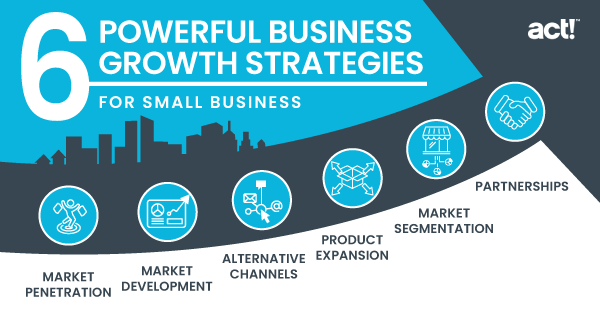
4. Product Expansion: Refresh or Renew Your Offerings
If sales are softening, it’s worth revisiting your product or service lineup before assuming the problem is marketing. Products and services have lifecycles, what resonated with customers two years ago may need updating to compete in today’s market.
A useful product review should address:
- Has new market research emerged that changes what customers want or expect?
- When did you last update your value proposition or key messaging?
- How do your offerings compare to competitors on features, quality, and price?
- What does customer feedback and review data consistently point to?
A forensic review of your product line, including features, pricing, competitive positioning, and customer sentiment, can surface opportunities to retire underperforming offerings, introduce adjacent products, or reposition existing ones for a new audience. Sometimes the product is fine; the market strategy just needs updating.
5. Market Segmentation: Reach the Right Customers with Precision
Rather than marketing to your entire customer base the same way, market segmentation lets you group customers by shared characteristics and create more targeted, relevant outreach for each group. Segmented campaigns consistently outperform broad ones because the message matches what the audience actually cares about.
Useful segmentation criteria for small businesses include:
- Purchase history and recency
- Product or service category interest
- Geography or location
- Customer lifecycle stage (new, active, at-risk, lapsed)
The right CRM platform can do much of this work automatically. By tracking customer interactions, purchase history, and engagement signals, a CRM helps you identify meaningful segments and build campaigns tailored to each, without requiring manual spreadsheet analysis. The result is more relevant outreach, higher engagement rates, and better conversion across the board.
6. Partnerships: Join Forces with Complementary Businesses
Strategic partnerships can open markets, add capabilities, and accelerate growth in ways that organic efforts alone can’t always match. For small businesses, partnerships don’t need to mean formal mergers or acquisitions, they can be as straightforward as a referral arrangement or a joint service offering.
Effective small business partnerships typically involve:
- Complementary services that help each business win more complete deals (a web designer and a copywriter, for example, or a plumber and an electrician)
- Shared audiences with non-competing offerings, enabling cross-promotion to qualified buyers
- Knowledge or resource sharing that fills gaps neither business could afford to address alone
The key is identifying partners whose customers have a need for what you offer and whose offerings create a natural next step for yours. A well-structured partnership can generate referrals, expand market reach, and build credibility faster than most other growth strategies.
Putting It Together: Growth Strategy Meets the Right Tools
These six strategies work best when they’re supported by systems that keep your team organized, your customer data centralized, and your follow-up consistent. A well-implemented CRM and marketing automation platform connects your market segmentation, outreach, pipeline, and customer history in one place, making it easier to execute on any of the strategies above without losing momentum between channels or team members.
Act! Named a 2026 CRMmys Finalist for Best CRM for Small Business
Act! was recognized by CRM.org in the 2026 CRMmys, an independent evaluation of CRM platforms on real-world usability, feature completeness, pricing transparency, and support quality for small businesses. Read the Act! CRMmys Finalist announcement on the Act! blog, or see the 2026 CRMmys results at crm.org.
Whether you’re just starting to formalize your growth strategy or looking to scale what’s already working, the combination of clear strategy and the right tools makes the difference between growth that stalls and growth that compounds.