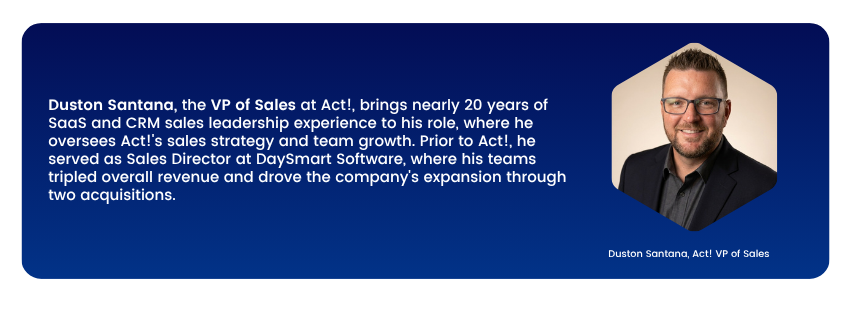


By Duston Santana, VP of Sales, Act!
If you’ve ever spent time fishing, you’ve probably dealt with a bird’s nest reel.

One bad cast, a little too much tension, and suddenly your fishing line is a tangled mess. Before you can get back to what you were trying to do, you have to stop and untangle everything.
I see a lot of SMB sales teams dealing with their own version of a bird’s nest reel every day.
Customer information is scattered across inboxes, spreadsheets, calendars, marketing platforms, accounting systems, handwritten notes, and individual memory. None of these are problems on their own, but over time, they form a web of disconnected information that’s difficult to navigate. Instead of focusing on relationships and moving opportunities forward, teams spend hours trying to piece together what happened, where it happened, and who knows what.
As a result, sales cycles slow, follow-up becomes inconsistent, and opportunities slip through the cracks. What looks like a pipeline issue on the surface is often something deeper: businesses are losing visibility into the revenue they already have in front of them.
The Underlying Revenue Problem for Most SMBs Is Visibility, Not Volume
When business leaders start seeing slowing revenue, one of the first conclusions they reach is that they need more leads. Whenever I hear that, I like to ask a simple question:
“What happened to the last hundred?”
The answer is rarely a lack of activity. Leads are being generated. Marketing is running campaigns. Referrals are coming in. Interest exists.
The problem is what happens next.
Some leads are followed up on immediately, while others sit untouched. Some move through the pipeline with unclear ownership, getting stuck between sales and marketing systems that don’t communicate effectively, or simply fall out of view altogether.
And at that point, more leads don’t solve the issue. They make it harder to see what’s already happening.
- Sales missing expansion, annual renewal, and retention opportunities already sitting in the customer base because no one noticed the signs until it was too late
- Marketing analyzing outdated or incomplete data, generating less relevant MQLs that are harder to convert
- Pipeline reporting becomes unreliable across tools and departments, which makes forecasting and decision-making harder than it needs to be.
The Deeper Problem: CRM Data Silos and Lost Customer Context
Most SMBs don’t lack the customer data they need to generate revenue effectively. If anything, they have more than they can realistically use.
Every interaction adds context, as emails, texts, meetings, proposals, website activity, support requests, purchases, and marketing engagement all contribute to the customer story over time.
But having information stored somewhere isn’t the same as having it available when and how it matters.
I recently spoke with a construction business owner who spends most of his day moving between job sites. Like many SMB leaders, he’s balancing customer conversations, scheduling, delivery, and business development at the same time. The information he needs exists, but it isn’t accessible in a way that fits how he works.
So like many others, he relies on memory, shortcuts, or whatever is fastest in the moment. Over time, that means valuable customer context stays trapped inside systems (or his head) instead of actively supporting decisions.
This is where most SMBs hit a structural limit. When systems stop reflecting reality, people stop trusting them. And when that happens, teams quietly rebuild processes around memory and manual work instead of data. It doesn’t break all at once, it just slowly becomes less reliable.
The Evolution of Customer Relationship Management (CRM)
This is also why the CRM category is starting to shift.
For decades, CRM systems were designed primarily to capture information: to log interactions, store contacts, and record activity. That foundation still matters, but it’s no longer enough on its own.
The next phase of CRM is less about recording what happened and more about helping teams understand what’s happening and what matters next.
Where AI Fits (and Where It Doesn’t) to Support Visibility
There’s a lot of noise around AI right now, but the most valuable applications of AI in SMB sales environments are usually the simplest. At Act!, we’re laser-focused on outcomes. Our goal is simple: help teams spend less time searching for context, and more time using it.
A few examples of where that shows up:
- Historical Summary Call Prep: A sales rep preparing for a call with a customer they haven’t spoken to in months can get a quick summary of past conversations, purchases, and open items instead of digging through email threads and notes.
- Post-Call Actions: After a meeting, a business owner can receive a structured recap with action items and follow-ups already captured, instead of recreating them manually.
- Quiet Pattern Detection: And when an account that was previously active goes quiet, a team can be alerted before that relationship quietly fades away or moves elsewhere.
Untangling the Sales Process: Why SMB Growth Depends on Visibility
When I think about where sales technology is headed, I keep coming back to that fishing analogy. The goal is to spend less time untangling the line so you can actually fish.
Most SMBs already have the customer information they need to make better decisions and build stronger relationships. Growth stalls when opportunity becomes harder to see, harder to act on, and easier to lose in the noise.
At the end of the day, technology works best when it helps businesses preserve what already makes them strong: real customer relationships, built on context, trust, and continuity over time. That’s where we’re headed at Act!.