


The contract is signed. Work begins. Everyone is busy. You’ve got the much-needed new business client on board.
But it’s all downhill after that.
No scheduled check-in. No onboarding recap. No milestone follow-up.
The result?
Six months later, your client feels disconnected from the brand and inevitably begins weighing their options. Uncertainty lingers over whether they’ll consider renewing their contract.
The issue here is that the proactiveness shown before the sale gets replaced with complacency after conversion, leading to a poor professional services client experience. You need to keep your clients engaged to get them to renew their contracts.
As a small business owner, here’s how you can achieve that.
Where SMB professional services firms drop the ball post-sale
Unlike enterprises, small businesses operate within tight budgets and staffing constraints, leading to burnout. In fact, small businesses lose 33 working days a year due to factors like fatigue.
The strain on resources puts a lot of impetus on the primary revenue driver: sales.
However, neglecting the post-sale experience can severely stunt recurring revenue growth. Here’s what causes post-sale churn, especially in firms with less than 25 employees.
1. Inconsistent follow-ups
When things run manually, your team only follows up when it remembers. There’s no post-sale follow-up process, so the check-ins don’t happen on a regular cadence, and you usually reach out only when something goes wrong. This reactive cycle creates a disconnect with the client.
2. Poor sales-to-delivery continuity
You’ve promised things when the client converts, but if you don’t support them in reaching those goals, they’ll feel like their expectations aren’t met.
Without structured guidance, they won’t discover the value of your services, or their time-to-value becomes so high that they lose interest.
3. Reactive support
If you aren’t pre-emptively monitoring potential friction points for your clients, you’re essentially waiting for them to churn. You need to solve issues before or as soon as the client encounters them.
4. No clear ownership of the relationship
Once a contract is signed, the sales team often disappears, leaving the client in a vacuum. Without a single, designated point of contact to “own” the experience, they are left to navigate your firm’s internal silos all by themselves, which could build frustration.
Why manual tracking breaks down as firms grow
Manual client tracking is manageable in the beginning, but these systems quickly stretch beyond their limits as you scale.
For instance, sticky notes or calendars may work when you’ve got five clients, but when you scale to 25, they bog your process down.
That’s because they:
- Offer no visibility across the team
- Don’t provide shared accountability
- Have no structured triggers
In a nutshell, manual tracking becomes an operational weakness as your organization grows. For sustained success, you need to create a scalable automation strategy.
Improve revenue with better follow up
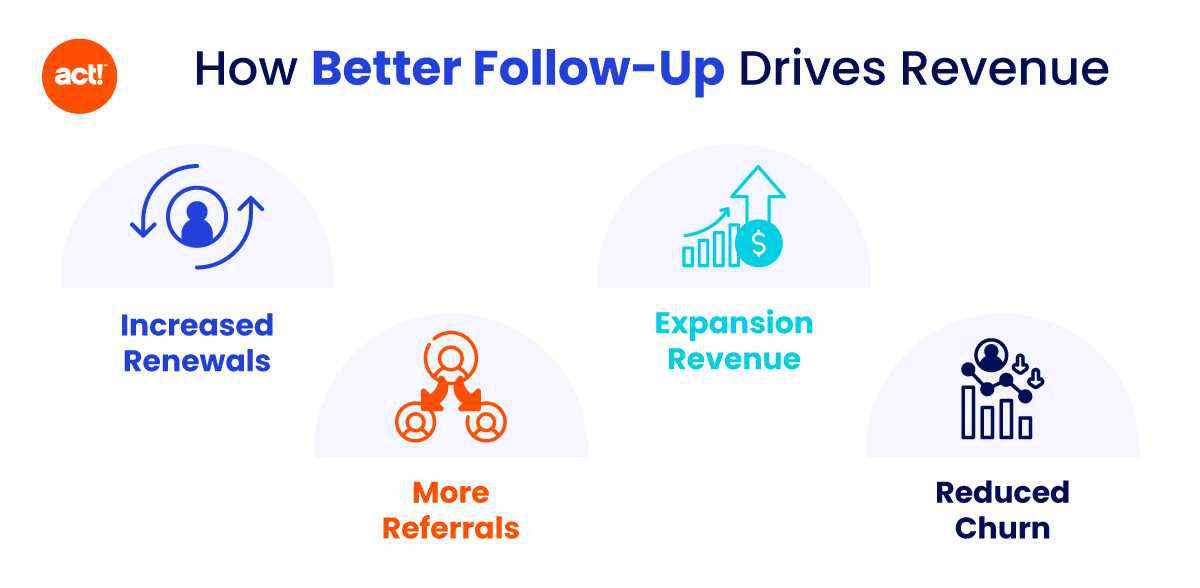
Consistent client engagement and client relationship management transforms a one-time transaction into a long-term, experience-led partnership.
Follow-ups help you identify and resolve friction points before they escalate, enabling you to secure the relationship and, more importantly, your bottom line. In essence, they improve client retention for professional services firms. Here’s how:
Increased renewals
Solid onboarding and proactive follow-ups accelerate time-to-value for your clients. When they face fewer hurdles, they’ll see tangible results early. Easy access to your support team leads to a superior experience, paving the way for contract renewals.
More referrals
Satisfied clients are your most effective sales force. When they’re satisfied with the results and the relationship with your SMB, they’ll be inclined to recommend you to other organizations, helping you get new customers and improving metrics like customer acquisition costs (CAC).
Expansion revenue
Proactive follow-ups help clients reach their goals regularly. This process builds trust gradually and turns you into a partner in their business growth story.
As their needs evolve and goals become bigger, they’ll likely opt for more services, increasing your customer lifetime value (CLV). In fact, 75 percent of consumers spend more on businesses that provide a good customer experience.
Reduced churn
Frequent check-ins act as an early warning system for dissatisfaction. By solving problems before they become a big deal, you reduce client churn. This leads to greater revenue, stronger customer retention, and more predictable cash flow.
CRM, email, and support as a system to create consistent client touchpoints
Manual outreach is inconsistent and unsustainable as you grow. To maintain high-quality engagement at scale, your tech stack must act as a single, connected system.
You need to tie CRMs, email, and customer support together into a smooth workflow.
CRMs give you access to client history, commitments, renewal timelines, and other important details. Some CRMs for professional services also provide email marketing automation to help you streamline follow-ups.
Finally, customer support’s insights help you resolve clients’ issues. Here’s are some customer retention strategies for SMB you can use to improve client retention.
1. Standardize onboarding
Every client should have the same experience when they start using your services. To automate this process:
- Set a trigger in your CRM to send out an onboarding email as soon as the deal is marked “closed.”
- Define a clear roadmap to meet their goals.
- Let your support team take over to provide a solid onboarding experience.
This creates clear expectations for the clients and gives them specific progress markers. It reduces time-to-value as they’ll have a clear idea of the milestones they need to reach.
2. Conduct quarterly check-ins
Replace “memory-based” outreach with a strict 90-day cadence.
Use the CRM to figure out when a client hits that mark and send out an automated follow-up email to arrange a meeting. Let the support team conduct these quarterly meetings to understand where things stand and what needs changing.
3. Automate milestone communication
Use email marketing to communicate milestones to your clients smoothly. Whether it’s renewal reminders, progress checks, new project updates, or educational content, use email to build a strong bond with the clients.
Consistent communication builds the trust necessary for long-term renewals.
4. Work toretainat-risk clients
Use the CRM to identify clients who have low engagement, missed/late payments, or reduced service usage. These are clients who are at risk of churning.
By flagging these at-risk accounts early, you can pivot from “damage control” to proactive recovery, saving the relationship before the client decides to leave.
Start retaining your clients
You don’t necessarily need to grow your client base exponentially to scale. Building robust relationships with your existing customer base suffices. Upsells, referrals, and retention help you with revenue growth.
And the key to building a solid relationship is regular, structured follow-ups. With a front-office solution like Act!, that becomes a reality.
You can send out automated emails, track client conversations, and personalize your interactions based on the holistic view of your relationship history, all from a single platform that’s also your CRM.
Try Act! now with our 14-day free trial to see how it can help your SMB forge stronger client bonds.

TL;DR
- SMB professional services firms often lose clients after the contract is signed due to inconsistent post-sale engagement.
- Sales receives priority, while onboarding, follow-ups, and relationship management lack structure.
- Inconsistent check-ins, reactive support, poor sales-to-delivery continuity, and unclear ownership increase churn risk.
- Manual tracking methods fail as firms grow, creating visibility gaps, inefficiencies and missed follow-ups.
- Retention improves when CRM, email automation, and proactive customer support operate as a unified system.
- Standardised onboarding, scheduled quarterly check-ins, automated milestone emails, and at-risk client monitoring create consistent touchpoints.
- Proactive, system-driven follow-up increases renewals, referrals, expansion revenue, and overall customer lifetime value.