


Your sales team closes the deal after weeks of calls, proposals, pricing discussions, and follow-ups. The client feels excited and ready to begin.
Then the file moves to delivery.
Your project manager opens the CRM, reviews the proposal, and asks: “What exactly did we promise?”
The contract shows the price. The proposal lists the services. But certain expectations discussed on sales calls never made it into the documentation.
As a result, when the delivery team begins serving the client and the work does not fully match what the client expected, friction starts.
This situation is common in growing service-based businesses, and it can damage the customer experience and create long-term retention problems.
In this article, we’ll explain why this misalignment happens and how an integrated CRM system can help you improve the handoff process so everyone stays aligned.
Where the Client Handoff Process Breaks Down in SMB Firms
As SMB service firms grow, sales teams move faster, delivery teams take on more accounts, and informal processes begin to show their limits.
That is usually when the client handoff process starts to break down.
To understand how this happens, let’s take a look at a few common patterns that show up across growing service businesses.
1. Overpromising to Close Deals
This is one of the most common causes of misalignment across industries.
During sales conversations, clients request small adjustments, pricing flexibility, or service customisations.
Sales reps often agree to close the deal, believing delivery can adapt.
When those assurances never enter the CRM, and delivery follows the documented plan instead of the spoken commitments, poor handoffs start to surface.
2. Undocumented Expectations and Siloed Workflows
Even when sales does not overpromise, misalignment occurs when expectations between sales and delivery are not clearly locked.
Files may list services and pricing but lack defined deliverables, timelines, success criteria, or key metrics.
Without these details in the CRM, teams rely on memory, creating siloed workflows, delays, and inefficiencies during onboarding.
3. Tribal Knowledge Instead of a Structured Sales Handoff
In many SMB firms, critical context stays with people instead of systems.
Sales “knows” what the client meant because they led the final call, but delivery was not part of that conversation. The sales to operations handoff happens through Slack messages or quick verbal updates.
Without real-time visibility in the CRM, silos form and finger-pointing follows.
The Hidden Costs of Poor Handoffs
When your client handoff process breaks down, the impact isn’t limited to a single account.
It affects how your teams work, how your workflows function, and how your customers experience your service.
Over time, these issues compound and create measurable business consequences.
Here are three ways poor handoffs impact your business.
1. Scope Creep and Workflow Inefficiencies
When your sales and service teams fail to document commitments clearly, scope creep is the most common result.
When delivery is unsure what sales committed to the client, they start making assumptions. They complete quick favours that were never part of the deal, add extra revisions, or adjust timelines to avoid friction.
Eventually, the client says, “That’s not what we thought we agreed to.”
At that point, your team absorbs the extra work to protect the relationship. Over time, these unplanned tasks consume real hours and create process bottlenecks.
2. Margin Erosion, Lost Revenue, and Missed Opportunities
Beyond workflow inefficiencies, poor handoffs directly affect your margins.
When delivery teams spend additional hours clarifying expectations, reworking deliverables, or managing confusion, those hours rarely get billed. Project managers shift into reactive mode instead of executing planned workflows, and teams begin to feel stretched.
Over time, this reduces profitability on each account.
Burned-out team members move more slowly, response times increase, and clients feel frustrated. It directly affects retention and future conversion rates.
What started as a documentation gap turns into lost revenue and long-term missed opportunities.
3. Early Customer Friction and Churn Risk
Poor handoffs also show up in the customer experience almost immediately. During onboarding, clients often repeat information they already shared with sales.
When your customer success team does not have full context, CSMs start from scratch instead of building on prior conversations.
This reset creates a post-sales disconnect where the client onboarding process feels disorganised.
Clients may not complain openly, but they notice the gaps. Eventually, this early friction weakens trust and increases churn risk long before renewal discussions begin.
Results of a Successful Client Handoff Process
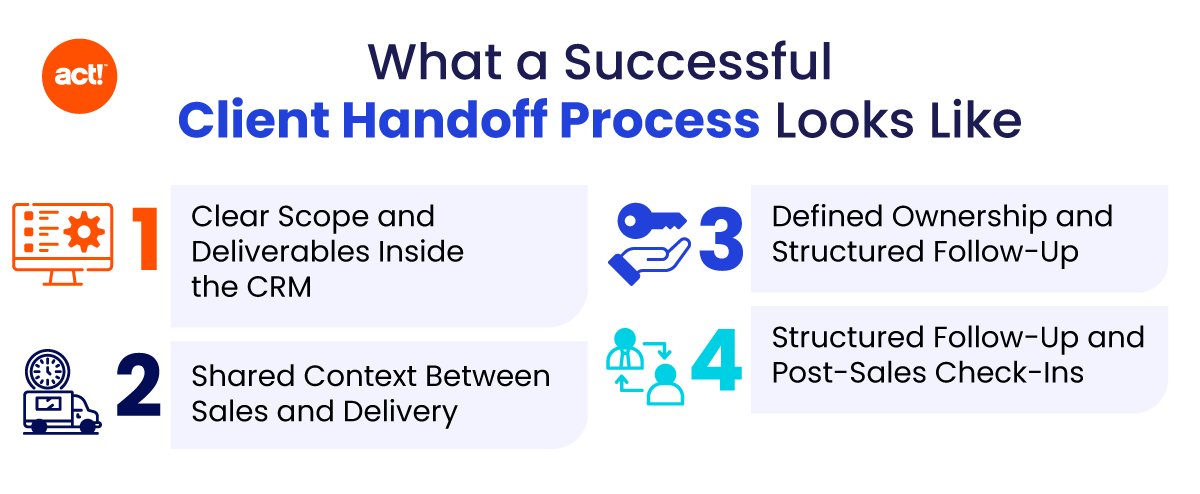
A successful handoff process does not rely on memory, Slack messages, or hallway conversations. It creates a documented bridge between sales, onboarding, and customer success.
Here are the top client onboarding best practices and how they translate into a successful handoff process.
1. Clear Scope and Deliverables Inside the CRM
Before delivery begins, the agreed scope must live inside your integrated CRM platform.
It should include defined deliverables, timelines, pricing terms, and success criteria that both sales and delivery can reference instead of relying on email threads or memory.
In a CRM, sales reps log commitments directly inside the account profile, and delivery teams access that information in real time.
When everyone works from the same source of truth, assumptions decrease and scope creep rarely occurs.
2. Shared Context Between Sales and Delivery
Documenting scope is only part of the solution. Delivery teams also need to understand the background behind the deal.
Why did the client decide to move forward? What specific pain points drove the decision? Were there objections during the sales cycle? Did the client express urgency or risk concerns?
A CRM allows sales teams to capture detailed call notes, meeting summaries, and interaction history within the client record.
When onboarding begins, delivery and customer success teams can review that full history.
They step into the relationship with context, not guesswork, which helps them communicate more confidently and build trust faster.
3. Defined Ownership and Structured Follow-Up
A strong handoff process also makes ownership clear. Before onboarding begins, your team should know who leads the account, who manages client communication, and who handles escalations.
When responsibilities are unclear, tasks get delayed, and accountability becomes difficult.
A CRM supports clearer ownership by allowing you to assign tasks, set deadlines, and track activities within each account record.
You can create structured follow-up workflows with scheduled check-ins, onboarding milestones, and reminders.
Instead of relying on memory or separate tools, your team works within one system and responds at the right time, not after issues surface.
4. Structured Follow-Up and Post-Sales Check-Ins
Even after onboarding begins, alignment depends on consistent follow-up. Without a clear system, check-ins happen irregularly and feedback arrives too late.
Clients may struggle quietly while your team assumes everything is on track.
With an integrated system, you can build follow-up workflows that trigger reminders, task assignments, and milestone reviews at the right time.
You can also capture client feedback inside the same record, creating feedback loops that support retention and reduce churn risk before small issues turn into larger ones.
Clean Client Handoff Checklist
Before you move a deal from sales to delivery, confirm that these steps are complete:
- Scope documented clearly inside the CRM
- Contract terms aligned with the approved proposal
- Expectations confirmed in writing with the client
- Internal briefing completed between sales and delivery
- Client onboarding roadmap shared and scheduled
- Automated follow-up workflows and check-ins activated
How CRM, Automation, and Real-Time Workflows Protect the Transition
An integrated CRM platform reduces miscommunication between your sales and service teams by centralising client data, commitments, and activity history in one place, and automating your workflows.
Here is how that structure changes the way your teams operate during the transition from sales to delivery.
CRM as the System of Record for Sales and Post-Sales Teams
With an integrated CRM and automation platform, every proposal, call note, pricing discussion, contract update, and task sits inside one account record.
Sales activity, onboarding steps, and service milestones connect to the same client profile.
Managers view dashboards that show account status in real time, track open tasks, and monitor progress without chasing updates.
This unified data keeps sales, delivery, and customer success aligned from day one.
Email Automation That Eliminates Bottlenecks and Silos
With a CRM, you can automate post-close summary emails that confirm scope, timelines, and next steps in writing.
Automated onboarding sequences assign tasks, send reminders, and trigger outreach at the right time. This reduces inefficiencies because your teams don’t have to wait for manual updates.
Written confirmation inside the CRM prevents misunderstandings and keeps sales, delivery, and customer success working from the same documented expectations.
Customer Success Without Resetting the Conversation
A CRM lets customer success managers see the full client history before the first onboarding call. They review prior conversations, commitments, objections, and agreed milestones inside the same record.
This visibility keeps the customer success team aligned and reduces the need to re-explain goals or revisit earlier discussions.
Over time, that consistency improves the customer experience, strengthens retention, and lowers churn risk.
Beyond tracking your pipeline, an integrated CRM platform protects delivery quality and long-term account value.
Sales Doesn’t End at “Closed Won”
Closing a deal begins the delivery phase, not the relationship. When your teams document expectations and share context inside a structured CRM, service becomes consistent and predictable.
If you want to see how a fully integrated CRM like Act! aligns sales and service with clarity and accountability, try it free for 14 days and experience the difference.

TL;DR
Successfully closing a sales deal is just the beginning of your relationship with a client. But the real work starts in delivery. When sales and service teams don’t align during the handoff, customers feel it immediately, and that early friction affects retention and profitability down the line.
What goes wrong:
- Sales commitments never fully enter the CRM.
- Deliverables, timelines, and KPIs remain unclear.
- Teams rely on memory instead of a documented process.
- Scope creep leads to unbilled work and workflow delays.
- Early onboarding friction increases churn risk.
How to prevent it:
- Document scope, pricing terms, and success criteria inside the CRM.
- Capture full sales context, including objections, urgency, and expectations.
- Create structured sales to operations handoff workflows with defined ownership.
- Automate follow-up emails and onboarding sequences.
- Give customer success full visibility so onboarding builds on prior conversations.