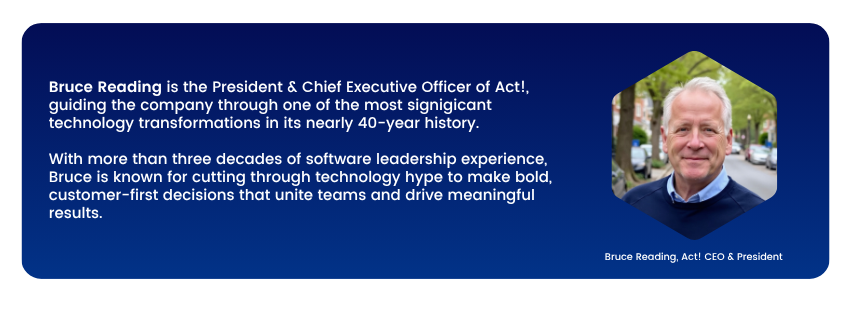



by Bruce Reading, Act! CEO and President
Small businesses are navigating the biggest technology shift since the rise of the internet.
The potential for Artificial Intelligence is staggering, almost unimaginable to think about. To say the AI has the potential to disrupt the software landscape across every industry is a laughable understatement. As with most disruptive technologies, there’s an enormous amount of noise surrounding what AI can actually mean for small and mid-sized businesses and just as importantly, how these businesses will be able to capture AI’s disruptive potential.
SMB leaders are no longer deciding whether AI matters for their business – we’re all coming to realize that it does (or will) in some way. The question today is instead about deciphering which AI technologies will genuinely help them, and which ones just add more complexity.
At Act!, we believe the answer comes down to business outcomes.
Does the technology help businesses strengthen customer relationships? Save time? Improve productivity? Reduce administrative burden? Help teams operate more efficiently? Provide for competitive differentiation?
If it does, it’s valuable. If it doesn’t, it’s just another distraction competing for attention (and subscription revenue).
That philosophy is shaping how we think about the future of small business technology and where we’re investing next.
What We’ve Learned from Small Businesses
For nearly four decades, Act! has worked alongside small and mid-sized businesses across industries ranging from financial services and real estate to manufacturing, plumbing, landscaping, consulting, legal, field services, and beyond.
And despite how much technology has evolved over the years, the core operational challenges SMBs face remain remarkably consistent.
Most businesses are trying to accomplish more with limited time, lean (or completely solo) teams, and growing customer expectations. They’re balancing sales, service, scheduling, communication, marketing, follow-up, reporting, and day-to-day operations, often across disconnected systems and processes that were added over time as the business grew.
What we consistently hear from customers is that they don’t want more technology to manage. They want better technology.
That means software that leads to:
- Less manual administrative work
- Better visibility into customer relationships
- Fewer disconnected systems
- Faster access to important information
- Simpler workflows that scale as the business grows
- Automation that supports business strategy
Most importantly, they want technology that works naturally within the way they already operate, allowing for focus on the product and or service of their business.
Small businesses generally do not have the luxury of pausing operations to completely reinvent their workflows every time the market shifts. They need tools that modernize the business while supporting customer relationships and processes they already have in place and depend on every day.
That reality has heavily shaped our approach to AI and automation.
The Future of SMB Technology Is Practical, Connected, and Integrated
There’s a tendency for B2B technology vendors to focus on buzzy terminology and flashy trends. But those usually turn out to be little more than short-lived hype, because the average SMB leader in the long run wants practical solutions that help them operate more effectively. It’s really that simple.
And it’s why we believe the future of small business technology will center around a few key principles:
Practical AI Built into Everyday Workflows
Small businesses should not need to become AI experts to benefit from AI.
The technology should work naturally within the workflows they already use every day, quietly helping teams move faster and operate more efficiently behind the scenes.
For example, one of the most universally disliked parts of sales and customer management is administrative work like note taking, activity logging, and follow-up management. Those tasks are necessary, but they also pull teams away from taking on more customer conversations and revenue-generating work.
AI can help automate much of that process.
That includes:
- Summarizing customer interactions
- Capturing important conversation details
- Assisting with follow-up communication
- Surfacing relevant customer history and context
- Helping teams prepare for meetings faster and with better information
That’s why our goal with AI is to focus on those pain points and reduce friction inside the systems they already rely on. Not to create more systems to manage.
AI That Improves Customer Context
You’ve probably heard it before, but it’s absolutely the truth: AI is only as useful as the data behind it.
One of the biggest challenges many SMBs face today is fragmented customer information spread across disconnected systems, inboxes, spreadsheets, notes, and communication tools. When data is fragmented, customer visibility becomes fragmented too.
But when everything about a customer (from the very first to the most recent touchpoint) exists together inside a connected environment, businesses gain significantly better context around their relationships.
That’s where AI becomes genuinely valuable.
Business owners, customer support, or sales teams may not remember every conversation, every interaction, or every detail across years of customer history. AI can help surface that information quickly and put it into context at the moment it matters.
At Act!, this is already shaping capabilities like AI-generated history summaries and AI-assisted content creation tools designed to help businesses communicate more effectively and operate more efficiently.
And we believe this is only the beginning. The long-term opportunity is helping businesses know their customers more fully, respond more intelligently, and strengthen relationships through better visibility and better timing.
Reducing Software Sprawl Through Connected Experiences
Another major shift happening in the SMB market is growing frustration around software fragmentation.
Over time, many businesses have accumulated separate tools for CRM, email marketing, scheduling, quoting, payments, communication, project management, customer follow-up, and reporting. A problem came up, and they solved it with the most cost-effective, fit-for-purpose tool they could find at the time.
Individually, each tool may solve a specific problem. But collectively, they often create operational complexity that wasn’t there before.
Teams spend time:
- Moving information between systems
- Managing duplicate records
- Switching between applications
- Re-entering customer information
- Searching for incomplete context
That approach becomes increasingly difficult to sustain as businesses grow. That’s why we believe the future of SMB software will be more integrated and connected.
It’s also why a few years ago we started (and will continue) to expand and unify capabilities across the Act! ecosystem into a single offering, including communication tools, marketing automation, appointment scheduling, customer engagement, mobile experiences, and AI-powered functionality – all in one place.
The goal is to help businesses move more seamlessly from engagement to transaction (and everything in between) without unnecessary operational friction. Our philosophy for AI will continue to strengthen this approach.
Mobile-First Business Operations
Business no longer happens exclusively behind a desk. It happens between appointments, at customer sites, while traveling, and across mobile devices throughout the day. That means mobile experiences can no longer be treated as secondary functionality.
As we continue investing in AI, automation, and customer engagement capabilities, mobile-first usability remains a critical priority. Businesses need access to customer context, communication tools, scheduling, and operational visibility wherever work is happening.
That includes expanding support for mobile and tablet workflows alongside broader omni-channel communication experiences across SMS, email, voice, appointment scheduling, and customer engagement.
Why Act! is Positioned for This Moment
For nearly 40 years, Act! has helped SMBs manage their operations. That experience has created a deep understanding of the operational realities small businesses navigate every day.
That experience continues to shape how we approach innovation at Act!.
Our focus has never been to chase hype cycles, but instead, we’re watching, adapting, and building practical technology that stays focused on what matters most to our customers.
That’s how Act! is cutting through the noise and building better technology for businesses like yours. Learn more about Act!
Ready to put AI to work for your business?
Act! brings CRM, email marketing, and AI-powered tools together in one simple platform built for small businesses like yours. Get organized, strengthen customer relationships, and grow — without the complexity. Start your free trial today.